Killing Tree Stumps in Utah: What Actually Works (and What’s a Waste of Time) | Darrell’s Tree Service
Why stumps are a bigger problem in Northern Utah than most people expect
If you manage a property in Ogden, Layton, or anywhere along the Wasatch Front, you already know the feeling: you finally get a tree removed, the site looks cleaner… and then you’re left staring at the stump like, “Now what?”
In Northern Utah, stumps don’t just “go away.” Our freeze/thaw cycles, dry summers, and compacted soils around commercial sites can slow natural decay and create a long list of headaches—trip hazards, mower damage, pests, and even surprise regrowth.
This guide breaks down what actually works for killing tree stumps in Utah (and what’s mostly a waste of time), so you can make a smart call for your site, your timeline, and your liability.
First: do you need to kill the stump, or remove it?
This is the most important distinction.
Killing a stump means stopping it from sprouting and speeding up decay. The stump stays in the ground.
Removing a stump means grinding it below grade (or excavating it) so the area can be used again.
For many businesses and commercial properties, “kill it and wait” isn’t ideal because:
It still creates a trip hazard and potential liability
It can interfere with snow removal, mowing, and landscaping crews
It can attract insects as it slowly breaks down
It keeps the space from being usable for replanting, signage, irrigation, or hardscape
If you need the area clean and usable fast, stump grinding is usually the fastest solution.
Internal links you may want next:
Stump Grinding
Tree Removal
Why stumps behave differently in Utah (and why that matters)
Northern Utah stumps tend to be stubborn for a few reasons:
Dry air + hot summers can slow microbial breakdown (especially in compacted, low-organic soils)
Freeze/thaw cycles can heave soil and expose roots, creating uneven ground around the stump
Irrigation patterns on commercial landscapes can keep the stump “wet enough” to invite fungi and insects, but not consistently enough to break it down quickly
Common local species (like cottonwood, elm, maple, and some fruit trees) can be aggressive about sending up shoots if the stump isn’t handled correctly
So when people ask about killing tree stumps here, what they’re often really asking is:
“How do I stop this thing from sprouting?”
“How do I avoid pests?”
“How do I get this out of the way without tearing up the whole landscape?”

What actually works for killing tree stumps in Utah
1) Stump grinding (best overall for speed + safety)
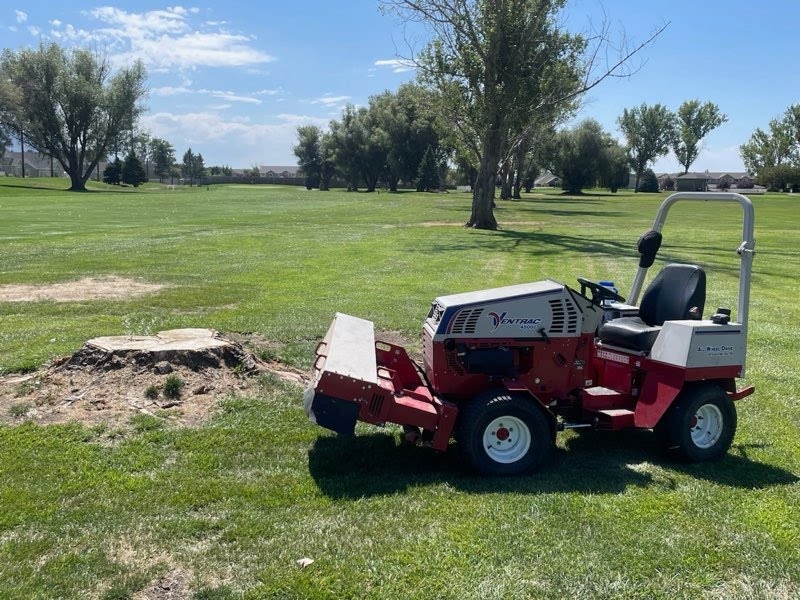
If your priority is a clean, usable space—especially on a commercial property—stump grinding is usually the most practical option.
Here’s why it works so well:
Removes the stump below grade so it’s no longer a hazard
Helps prevent most regrowth (especially when ground properly)
Lets you restore the area with soil/seed/sod or replanting
Avoids the disruption of full excavation
Typical timeline: same day service for many stumps, with immediate improvement to the site.
Best for: HOAs, churches, retail centers, office parks, schools, municipalities, and homeowners who want the job “done-done.”
Learn more here: Stump Grinding in Northern Utah
2) Drill-and-treat stump killer (works, but it’s slower than people think)
The classic method for killing tree stumps is drilling holes into the stump and applying a stump killer product.
It can work—especially for stopping sprouting—but it’s not instant.
How it works (simple version):
You drill holes into the fresh stump
Apply the product so it can soak into the living tissue
Over time, it reduces the stump’s ability to send up new growth and can speed decay
What matters most:
Freshness: It works best when applied soon after cutting.
Hole depth and spacing: Too shallow or too few holes = weak results.
Moisture: Utah’s dry conditions can reduce absorption.
Typical timeline: weeks to months to fully stop activity; longer for decay.
Best for: low-traffic areas where you can wait, and where the stump isn’t a liability.
3) Cutting and repeatedly removing sprouts (works… if you’re stubborn)
If you’re dealing with a species that wants to regrow, one low-tech approach is simply cutting sprouts as they appear—again and again—until the stump runs out of stored energy.
This can work, but it’s labor-heavy and easy to lose the battle if it’s a high-vigor species.
Typical timeline: months to over a year.
Best for: small residential stumps where time matters more than convenience.
4) Professional removal planning (best for commercial sites with constraints)
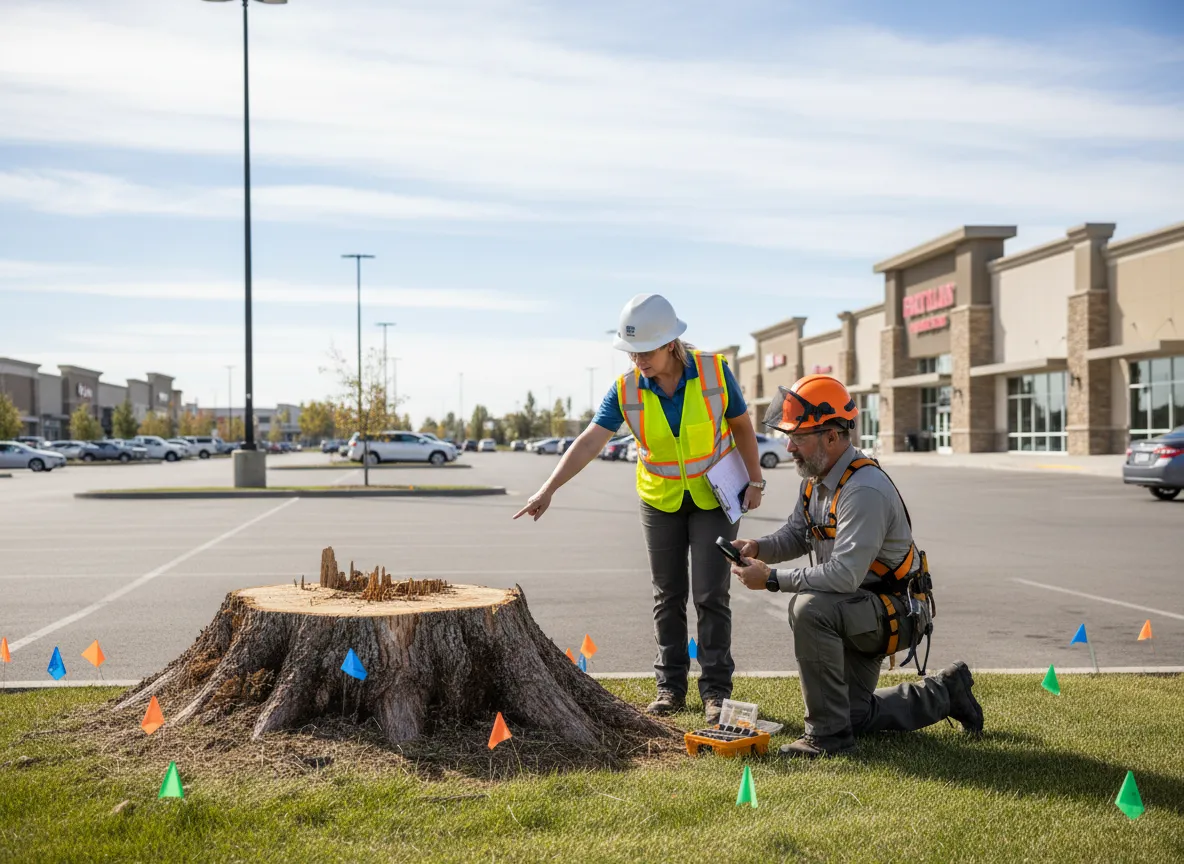
On commercial properties, stump decisions often involve:
Underground utilities
Irrigation lines
Sidewalks and ADA pathways
Parking lot edges
Tenant visibility and foot traffic
In those cases, the “best” method isn’t just about killing the stump—it’s about reducing risk and protecting the site.
If you’re managing multiple locations or coordinating vendors, it’s worth having a pro look at access, safety, and the best approach.
Related services:
Commercial Tree Services
Tree Trimming & Pruning
What’s usually a waste of time (or creates bigger problems)
Burning the stump
People try this every year, and it’s rarely the clean “campfire solution” it sounds like.
Why it’s often a bad idea:
It can be a fire risk, especially in dry seasons
It can damage surrounding turf, roots, and irrigation
It can smolder underground and create unpredictable hazards
It often doesn’t burn deep enough to solve the real problem
For commercial properties, it’s also a liability nightmare.
Pouring bleach, diesel, or random chemicals
This is one of those internet tips that sounds tough but doesn’t reliably solve the problem.
Bleach doesn’t “kill” a stump effectively in a controlled way
Fuel products can contaminate soil and create safety hazards
You can harm surrounding plants and landscaping
If you’re trying to manage a professional-looking property, this approach usually backfires.
“Just cover it with dirt”
Covering a stump can hide the problem for a bit, but it can also:
Create a soft spot that settles later
Encourage decay in a way that attracts insects
Leave a hidden trip hazard
If you need the area safe and level, grinding is the cleaner fix.
Safety and liability: the part commercial properties can’t ignore
For HOAs, property managers, churches, and businesses, stumps are more than an eyesore.
They can be:
A trip-and-fall hazard
A mower and snowplow hazard
A problem for pedestrians, kids, and older visitors
A risk near sidewalks, parking lots, and entryways
If you’re responsible for the site, the question isn’t just “How do I kill it?” It’s “How do I reduce risk and keep the property looking cared for?”
That’s why stump grinding is so common for commercial work—it solves the hazard, not just the biology.
How long does it take for a stump to rot in Utah?
This is the question everyone asks after they decide not to grind.
In Northern Utah, a stump can take several years to break down naturally, depending on:
Tree species (hardwoods often take longer)
Stump size
Soil moisture and irrigation
Sun exposure
Whether the stump is actively sprouting
If you’re hoping it’ll be gone by next season, natural decay usually won’t match that timeline.
When stump grinding is the fastest solution (and the smartest one)
If any of these are true, stump grinding is usually the move:
The stump is in a high-traffic area
You need to mow, plow, or maintain the space cleanly
You’re re-landscaping, replanting, or installing irrigation
You’re managing a site where appearance matters (retail, office, HOA common areas)
You don’t want to deal with repeat sprouting
And if you’re in places like Roy, Clinton, Clearfield, Sunset, West Haven, or Brigham City, you already know how quickly seasonal weather can turn a small hazard into a bigger maintenance issue.
A practical decision guide (quick and honest)
Here’s a simple way to choose the right approach:
Do you need the area usable within days?
Yes → grind it.
No → keep going.
Is the stump near walkways, parking, entrances, or common areas?
Yes → grind it (liability).
No → keep going.
Is it sprouting aggressively?
Yes → grind it or drill-and-treat immediately.
No → you can wait, but expect a long decay timeline.
Do you have irrigation lines/utilities nearby?
Not sure → have a pro assess before you dig, burn, or pour anything.
What Darrell’s Tree Service recommends (based on real Northern Utah properties)
We’ve worked on thousands of properties across the Wasatch Front—from residential yards in Pleasant View and Harrisville to commercial sites in Ogden and Layton.
In most cases:
Commercial properties benefit most from stump grinding because it solves the safety and maintenance problem immediately.
Residential properties sometimes choose drill-and-treat if the stump is out of the way and they’re not in a rush.
Either way, the best results come from doing it right the first time—especially with Utah’s climate and the way some local species love to regrow.
FAQs about killing tree stumps
Will a stump die on its own?
Yes, eventually. But “eventually” in Utah can mean years, and it may sprout in the meantime.
Can I just cut it flush to the ground?
You can, but it may still sprout, and it can remain a hidden hazard—especially once grass grows over it.
Does stump killer work on old, dry stumps?
It’s far less effective. Most products work best on fresh cuts where the stump can still absorb treatment.
Is stump grinding messy?
There will be wood chips, but a professional crew can contain and clean up the area so it’s ready for restoration.
The bottom line
If you’re trying to decide between “killing” and “removing,” here’s the honest truth: killing tree stumps can work, but it’s slow—and for many Northern Utah businesses, slow equals ongoing risk.
If you want the safest, cleanest, fastest outcome, stump grinding is usually the best solution.
Ready to get rid of that stump without the guesswork?
If you’re in Ogden, North Ogden, Pleasant View, Harrisville, Riverdale, Roy, Clinton, Clearfield, Sunset, Layton, South Weber, West Haven, Hooper, Farr West, Marriott-Slaterville, or Brigham City, we can take a look and recommend the safest, most cost-effective option for your property.
Schedule a consultation or request a free estimate here: Book an appointment with Darrell’s Tree Service
